
Portable Intermittent Fault Detector™
(PIFD-512™)
37-pin D-sub Interface Test Adapter (ITA)
Test for Smart Hunter TH-S711 Radar Digital Signal Processor Power Supply (DSPPS) and Receiver & Frequency Synthesizer Power Supply (RFSPS)
Test Summary
Introduction:
Universal Synaptics (USC) performed Portable Intermittent Fault Detector™ (PIFD™) testing with our Indonesian partners on two components that support the Smart Hunter TH-S711 Radar for REDACTED at Depohar REDACTED, Satuan Pemeliharaan REDACTED, utilizing the following equipment:
- Portable Intermittent Fault Detector™ (PIFD™) – test was conducted with a 512 test point version of the PIFD
- USC-PIFD-00512
- NSN: 6625-01-696-1235
- 50-pin D-Sub cable Interface Test Adapter (ITA) to electrically connect the PIFD to the Unit Under Test (UUT). A 50-pin D-sub interface cable was modified and terminated to a 37-pin opposite-gender mating connector to enable direct electrical access to the UUT
- Handheld vibration tool to simulate operational vibration of the UUTs during PIFD testing
Location:
- REDACTED, Indonesia
Background:
Radar Maintenance leadership and technicians at Satuan REDACTED were briefed about the advanced Intermittent Fault Detection (IFD) maintenance and sustainment technology solution to reduce No Fault Found (NFF) test results in radar components and wiring systems, decrease maintenance turnaround times (TAT), and reduce overall maintenance costs associated with manually pinning out components and wire harnesses with traditional tools such as Digital Multimeters, etc.
Many components were reviewed to determine whether on-site plug-and-play IFD testing could be demonstrated. The DSPPS and RFSPS were selected due to the availability of an opposite gender 37-pin mating connector that was removed off another interface unit. Both UUTs were functionally tested earlier in the day on existing Stage-3 Peculiar Support Equipment, and it was communicated that they passed those conventional Pass/Fail Tests.
NFF test results or “ghost faults” were discussed during the briefing with regard to different radar applications at Satuan REDACTED, including mobile radars and stationary radars. Undetected and hence unrepaired intermittent failures have many names across maintenance and sustainment communities such as NFF, No Evidence of Failure (NEOF), Cannot Duplicate (CND), A-799, “gremlins” and “ghost faults” and are extremely costly in the maintenance of components and Electrical Wiring Interconnect Systems (EWIS).
Conventional single-circuit sampling Digital Multi-Meters (DMMs) and conventional single-circuit serial scanning test equipment, functional bench tests, and troubleshooting methods have been proven by the U.S. Department of Defense (DoD) to be insufficient to remediate or reduce NFF test results. Source: U.S. DoD Report to Congress, MIL-PRF-32516
The PIFD is purpose-built to detect and isolate intermittent failures which are conclusively linked as the prime driver of high NFF test results in components, wiring systems, and sub-systems. The goal of this demonstration effort was to validate the utilization of the PIFD to detect and isolate intermittent faults that conventional test tools and testers are unable to detect or isolate, reduce NFF test results, increase time-on-platform, and demonstrate the advanced capabilities of AutoMap™. The PIFD is the only objectively proven test capability to reliably detect and isolate intermittent faults in compliance with DoD MIL-PRF-32516.
PIFD testing was conducted on two (2) components, one (1) DSPPS and one (1) RFSPS. No maintenance or test data was provided, and no Test Program Set (TPS) was developed before on-site arrival on 21 April 2026 to demonstrate the PIFDs AutoMap™ automatic TPS generation capability, ease of use with minimal training, automated continuity and shorts tests, and advanced intermittent fault detection and isolation diagnostic capability.
PIFD Test Functions:
- AutoMap – discovers the as-wired configuration without need for wiring schematics / OEM data
- Continuity – tests for open circuits and measured resistance against established AutoMap baseline (open circuits / high resistance tests)
- Shorts – provides shorted circuit indications and shorts tracing
- Intermittence – monitors all circuits simultaneously and continuously to detect and isolate all Three Stages of an Intermittent Fault (Figure 1) in compliance with DoD MIL-PRF-32516
- Fault Isolation – determines root cause of detected intermittent faults through programmatic isolation and visual identification

Portable Intermittent Fault Detector™ (PIFD™), NSN: 6625-01-696-1235
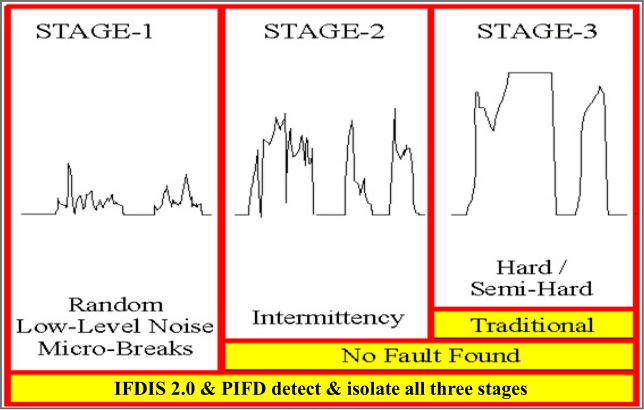
Figure 1 – Three Stages of an Intermittent Fault
Stage 1 – random low-level nanosecond micro-breaks, likely not operationally evident yet, but on curve of degradation to become Stage 2
Stage 2 – intermittent failure in operation, maintenance tests and it passes, marked as NFF. On curve of degradation to become Stage 3.
Stage 3 – semi-hard or hard failures, Automatic Test Equipment (ATE), functional test benches, and troubleshooting tools, such as Digital Multimeters, designed to detect hard faults (open circuits or shorted circuits), unable to detect intermittent faults.
Test Procedures: DSPPS and RFSPS
- AutoMap™ – discovers the as-wired configuration of the UUT.
- Continuity – tests for open circuits and measures resistance against established AutoMap baseline (open circuits / high resistance tests)
- Shorts – provides shorts indication and shorts tracing
- Intermittence – monitors all circuits, simultaneously and continuously to detect and isolate intermittent faults
- Fault Isolation – determines root cause of faults through programmatic isolation of detected intermittent faults
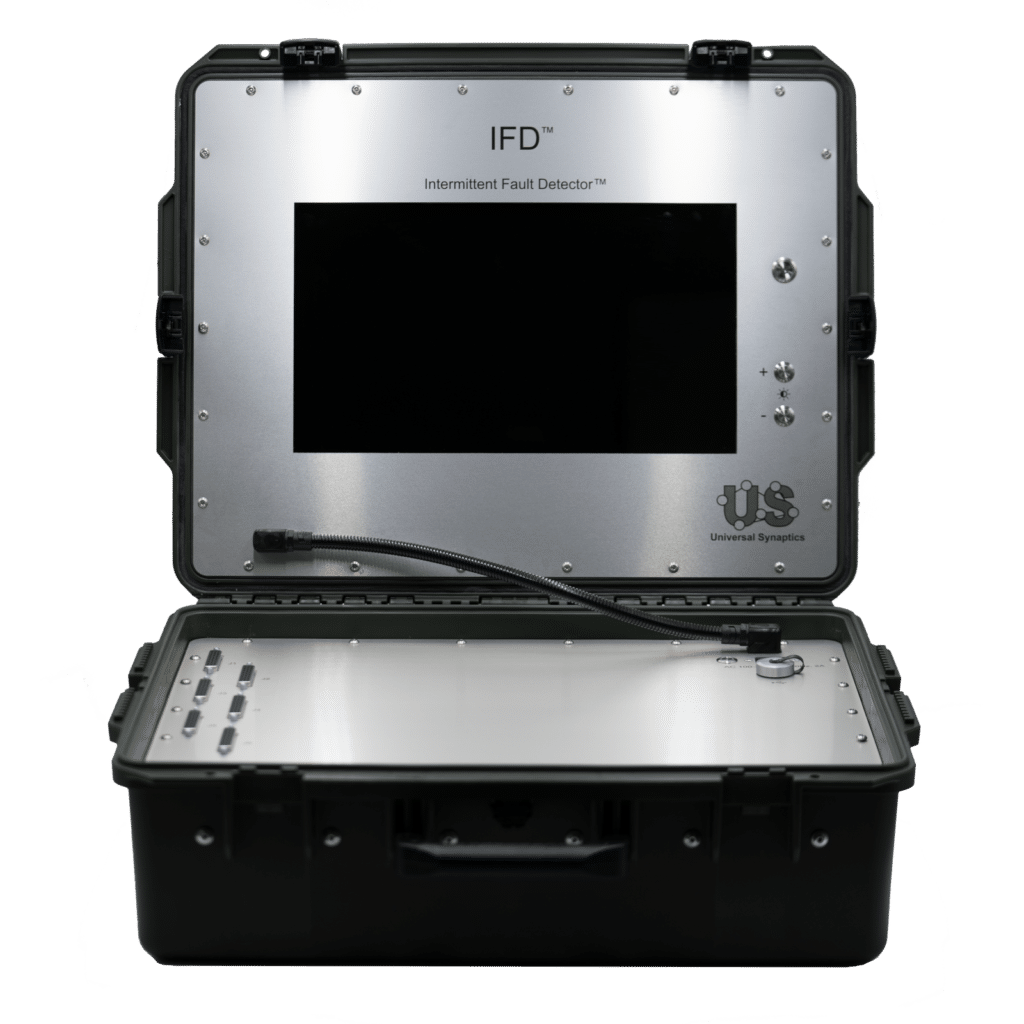
Portable Intermittent Fault Detector™ (PIFD™), NSN: 6625-01-696-1235
Results:
Digital Signal Processor Power Supply (DSPPS)
P/N: DSPPS-2023
S/N: DSPPS-01-2023-DSP
Full DSPPS Test Report on Next Page
Test #1:
- AutoMap discovered the as-wired configuration of the DSPPS. This step took approximately two minutes for AutoMap to complete. No pre-programmed information was entered into the PIFD. AutoMap demonstrated the time savings provided by utilizing AutoMap Artificial Intelligence, and machine learning automatic test program set (TPS) generation process. AutoMap identified 10 accessible conductive nodes through the external interface. Active DC-DC converter modules and energy storage components (e.g., converters, inductors, capacitors) inherently limit passive continuity traversal; therefore, internal functional paths are not represented in the AutoMap topology.
- Continuity testing conducted – no open circuits present in the DSPPS. Measured resistance variations were observed on capacitor networks. These are expected characteristics due to charge/discharge behavior and do not indicate faults.
- Shorts testing conducted – no short circuits were present in the DSPPS as indicated on the report as “Passed”.
- Intermittence testing conducted – three (3) intermittent fault events were detected and isolated on Test Point 32 under light vibrational stimulus. This component had passed functional bench testing earlier the same day, demonstrating that conventional test methods did not detect this degradation.
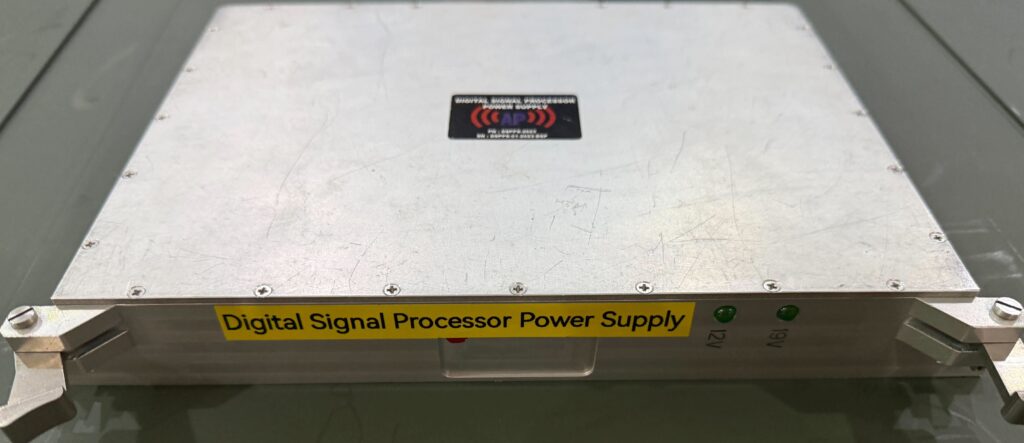
DSPPS Component
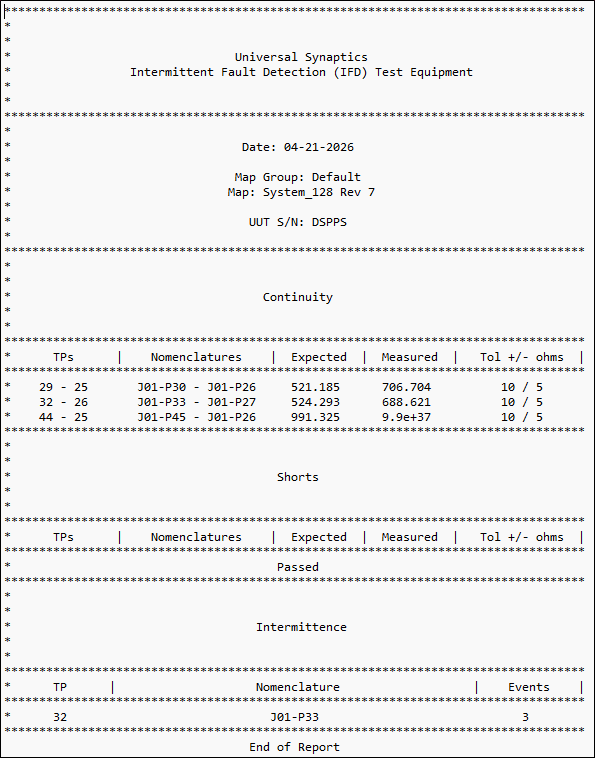
DSPPS Test Report Output from PIFD
Results:
Receiver & Frequency Synthesizer Power Supply (RFSPS)
P/N: RFS-2023
S/N: RFS-01-2023-PS
Full RFSPS Test Report on Next Page
Test #2:
- AutoMap discovered the as-wired configuration of the RFSPS. This step took approximately two minutes for AutoMap to complete. No pre-programmed information was entered into the PIFD. AutoMap demonstrated the time savings provided by utilizing AutoMap Artificial Intelligence, and machine learning automatic test program set (TPS) generation process. AutoMap identified 19 accessible conductive nodes through the external interface. Active DC-DC converter modules and energy storage components (e.g., converters, inductors, capacitors) inherently limit passive continuity traversal; therefore, internal functional paths are not represented in the AutoMap topology.
- Continuity testing conducted – no open circuits present in the RFSPS. Measured resistance variations were observed on capacitor networks. These are expected characteristics due to charge/discharge behavior and do not indicate faults.
- Shorts testing conducted – no short circuits were present in the RFSPS as indicated on the report as “Passed”.
- Intermittence testing conducted – multiple intermittent fault events were detected across five (5) distinct test points, including Stage 2 intermittence, indicating active degradation that is operationally relevant yet undetectable by conventional testing.The following test points were identified as having one or more intermittent events when vibrational stimulus was applied:
- Test Point 24 J1-25 19 events
- Test Point 8 J1-08 3 events
- Test Point 40 J1-41 1 event
- Test Point 1 J1-01 1 event
- Test Point 22 J1-23 2 events
This asset had also recently passed functional bench test, indicating that the intermittence test from the PIFD monitors to detect and isolate intermittent faults / “ghost faults” that are undetectable by other tools or test equipment.
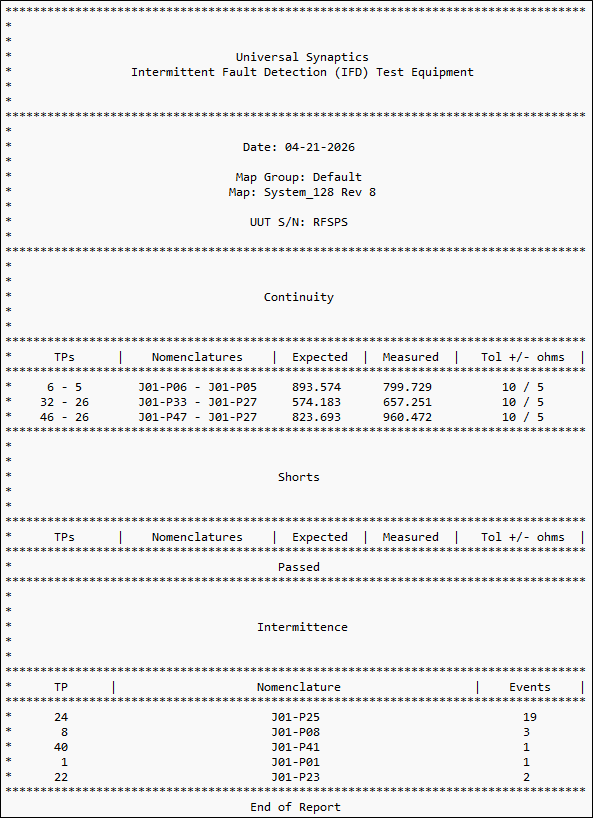
RFSPS Test Report Output from the PIFD
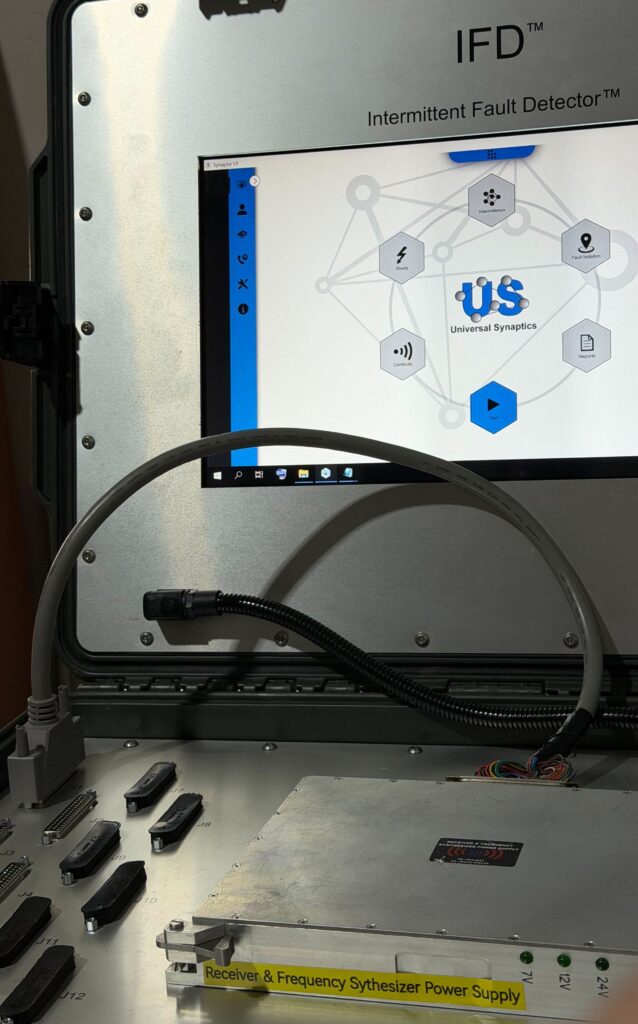
RFSPS Component Connected to PIFD 512
Key Findings:
- Both DSPPS and RFSPS passed conventional functional testing but exhibited intermittent faults under IFD testing
- Intermittent faults were detected across multiple test points, including Stage 2 degradation
- AutoMap successfully generated test programs in approximately 2 minutes with no prior data
- Detected faults were stimulus-dependent (vibration-induced) and would likely result in:
- No Fault Found (NFF) conditions
- Intermittent operational failures
- Demonstration validates that:
- Conventional test methods are insufficient for detecting intermittent faults
- PIFD provides unique and necessary diagnostic capability
Observations:
- Once the opposite-gender mating connector was located, the Satuan REDACTED team quickly and accurately fabricated a simple Interface Test Adapter (ITA) using a Universal Synaptics-supplied 50-pin D-sub cable. The cable was modified and terminated to the 37-pin mating connector, enabling direct electrical access between the UUT and the PIFD.
- The Satuan REDACTED team is very capable of easily expanding test capabilities through manufacturing ITAs to connect most, if not all, of their radar components that were observed by Universal Synaptics to the PIFD
- Conventional single-circuit scanning test sets, digital multi-meters, and functional ATE are not designed to find intermittent faults that are consistently detected and isolated by the PIFD.
- Once the cable set was manufactured, the test project was completed in an hour through plug-and-play process of AutoMap and the IFD test suite.
- Satuan REDACTED is a highly technical and capable group to easily expand the use of the PIFD to reduce maintenance hours and costs through the simplified and automated continuity and shorts testing, but most importantly, through the eradication of NFF test results caused by intermittent faults on radar components and their associated harnesses and cable sets.
- IFD technology is also very beneficial to use for detecting and isolating intermittence in existing cable sets used on other test systems. Satuan REDACTED has many testers with associated harness that will function even better when fully intermittent free through application of the PIFD.
Summary:
The reliable electronic functionality of REDACTED radars is required to ensure many vital aspects for the Republic of Indonesia. Equally important is the reliable functionality of test systems and interface cables that connect test systems to the respective weapon system wiring harnesses. Intermittent components, harnesses, and cable sets render end item components and systems unusable and often considered to be Beyond Economic Repair. NFF test results cost readiness and maintenance budget as maintenance professionals tasked with ensuring system readiness are unable to decipher if the “ghost faults” are due to intermittent components, system wiring harnesses, or both. Proven advanced test technology, such as the PIFD, is required to ensure weapon system readiness, quick and comprehensive maintenance outcomes, and root cause failure analysis and repair. The PIFD has been exhaustively studied by the United States Department of Defense for nearly two decades and has been objectively proven in multiple maintenance domains across every major Department of Defense weapon system.
Universal Synaptics’ patented Intermittent Fault Detection technology has been proven to increase system readiness, availability, and reliability. As proven by this demonstration, the PIFD, once implemented, will increase the reliability of the component and wiring harnesses it is applied to by ensuring open circuits, shorted circuits, and intermittent circuits are rapidly identified and repaired, breaking the NFF cycle caused by “ghost faults”. The PIFD is wholly agnostic and can be utilized on any system, components, or harness with adequate test point coverage. Reductions in NFF, root cause failure data, and accurate repair have been proven to significantly increase radar readiness in every instance where IFD technology has been applied. Early detection and isolation of intermittent faults prevents unnecessary component replacement, reduces troubleshooting time, and directly improves radar system availability and mission readiness.